What is
‘Developmental Trauma?’
Developmental trauma refers to chronic, repeated exposure to adverse experiences during childhood, especially within caregiving relationships. Unlike a single incident trauma, it occurs over time and affects the developing brain, identity, and sense of safety.
Developmental Trauma Developmental trauma refers to chronic exposure to adverse experiences during childhood, particularly within caregiving relationships. Unlike acute trauma, which stems from a single overwhelming event, developmental trauma unfolds over time and becomes embedded in the child’s developing brain, body, and sense of self. Because these experiences occur during critical periods of growth, the effects are often not limited to isolated symptoms but instead shape emotional regulation, identity, and relationships across the lifespan.
In recent decades, advances in neuroscience and psychology have shifted how clinicians and researchers understand trauma. Rather than viewing trauma solely as a psychological response, developmental trauma is now recognized as as neurodevelopment condition - one that alters the structure and functioning of the brain. This page will introduce key themes in developmental trauma research including brain development, the role of relationships, the impact of chronic stress, and implications for treatment.
Sensitive Periods
Synaptic pruning: Connections which are frequently used, due to repeated experiences, are strengthened, while unused connections are eliminated. This is how the environment literally shapes brain structure.
Myelination: Neural pathways become coated with myelin, which allows the communication between neurons to be more efficient and faster. This makes frequently used skills more efficient over time.
During these periods, the brain is essentially being wired based on experiences. This is why they are referred to a sensitive and/or critical periods of time as certain skills and systems are much easier to develop optimally during these periods of time.
Maltreatment During Sensitive Periods
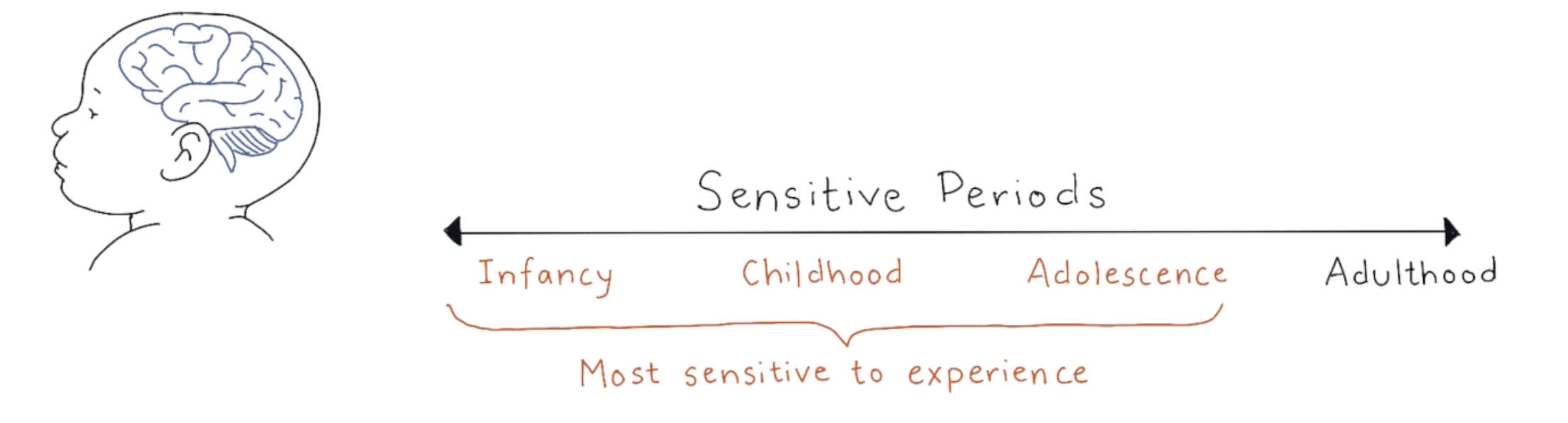
Sensitive periods refer to times in development when an individual is especially influenced by their environment. During these periods, the brain undergoes rapid and substantial changes that can continue to affect the individual long after the period has passed.
Infancy, childhood, and adolescence are all considered sensitive periods because environmental experiences play a key role in shaping brain development. During this time period, the brain is undergoing intense development and reorganization, making it especially vulnerable to environmental input.
Rapid Synapse formation: The brain is creating a large number of neural connections. This allows for the brain to be highly adaptable.
During sensitive periods, maltreatment doesn’t just affect behavior, it can shape the architecture of the developing brain, organizing it around survival rather than safety. Neuroscience research on trauma and maltreatment during sensitive periods have identified three key neural networks which have been impacted in children who have experienced maltreatment.
Strengthening of threat-detection networks
Neural networks involving the amygdala and related limbic structures involved in the threat and stress response being highly active and strongly connected. As a result, the brain becomes biased towards detecting danger, and neutral or ambiguous cues are more often interpreted at threatening. These pathways become the default because they were used repeatedly. This is an example of “the more the system is activated, the stronger it becomes.” This can result in increased hyper vigilance, a rapid fight/flight response, and difficulty distinguishing real danger from perceived threat.
Alterations in the reward system (motivation and pleasure)
The reward system is comprised of key structures in the striatum, nucleus accumbent, and dopamine pathways. These systems are responsible for how we feel pleasure, form habits, and motivate behavior. For children who have experience maltreatment neuroscience research has shown that the reward system may become under active or inconsistently activates, which leads individuals to experience positive experiences less frequently or unpredictably. Within the reward system, there is reduced sensitive to reward and difficulty linking actions to positive outcomes. The impact of this is that individuals may experience anhedonia or a reduce ability to feel pleasure, reduced motivation, and increased risk-raking or seeking intense stimuli.
Reorganization of the Memory System
The memory system is responsibly for encoding memories and aid in our ability to learn and retain information, this system is comprised of the hippocampus and medial temporal lobe. During maltreatment, there is chronic stress and elevated cortisol which can disrupt hippocampal development, and memory encoding may become biased towards emotionally intense or threatening events. At a network level, we see that there is a strong encoding of fear-based or traumatic memory, as well as a weaker integration of context of memory such as time, place, and sequence. For individuals with child maltreatment this can look like difficulty distinguishing between past and present experience, intrusive memories or fragmented recall of events, and a overgeneralization of fear.
During sensitive periods, maltreatment wires these system to work together in a way that prioritizes survival over exploration connection and reward. These patterns can persist over time, but that can also be reshaped with new consistent experiences of safety and support.
The “Double Hit” of Developmental Trauma
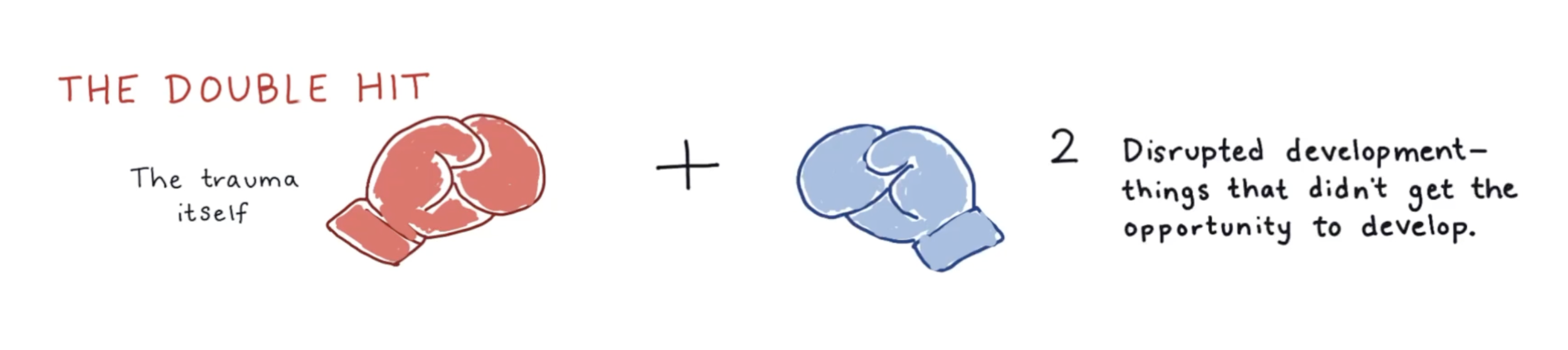
The child is not only exposed to harmful experiences, but also deprived of the conditions needed to have healthy brain development, creating a compounding (or “double”) impact which is not as prominent in other forms of trauma.
Latent Vulnerability: refers to these hidden, neurodevelopment changes that arise after early maltreatment. These changes may not cause immediate problems, but they can increase risk for difficulties later in life, especially when new stressor are present.
Cognitive and Academic Functioning
Early maltreatment can shape the development of brain networks which are involved in attention, memory, and executive functioning, particularly those connected to the prefrontal cortex and hippocampus. As a result, individuals may have difficulty concentrating, organizing tasks, and making decisions. These challenges can translate to academic struggles or difficulties maintaining consistent performance over time.
Physical Health
Chronic activation of the stress response system during development can lead to long-term change in the body, including immune and inflammatory processes. Over time, this can increase the risk for a range of health conditions, such as cardiovascular or metabolic disorders. This reflects the cumulative burden of stress on the body, often referred to as allostatic load.
Social and Relational Functioning
Early experiences inform expectations about safety and trust, individuals who experience maltreatment during sensitive periods may develop patterns of hyper vigilance and mistrust in relationships. They may be more likely to interpret ambiguous social cues as threatening or struggle forming secure attachments. This can influence friendships, romantic relationships, and everyday interactions often making relationships feel unpredictable and unsafe even when they are not.
Motivation and Pleasure
Individuals may find it hard to feel rewarded by everyday activities or to sustain goal-directed behavior. In some cases, this can contribute to disengagement, while in others it may lead to seeking out more intense or immediate forms of stimulation.
Behavioral Regulation
Altered connectivity between the brains treat system and regulatory system can make it harder to manage emotions and impulses. This may appear as heightened reactively, difficulty tolerating frustration, or emotional shutdown or dissociation. There responses are often adaptive in the context in which they developed, but they can become disruptive in environments that require flexibility and self-regulation.
Why is This Important?
Understanding concepts like the double hit of developmental trauma is essential in the field of child maltreatment because it fundamentally changes how we interpret a child’s behavior, needs, and long-term risk.
Children who have experienced trauma and maltreatment show predictable symptoms and patterns that are related to their neurocognitive adaptations to early environments. Understanding these brain changes helps professionals avoid mislabeling children as oppositional, unmotivated, or disordered, and instead recognizes these behaviors as meaningful and context-driven.
This understanding is also critical for early identification and prevention. Vulnerability following child maltreatment is present even when the child does not show obvious difficulties until later in developmental stages. Understanding this trajectory allows professionals to intervene earlier, even when a child appears “functioning,” rather than waiting for more severe problems to develop.
This information can also inform intervention and treatment approaches. If maltreatment alters threat, reward, and memory systems, then effective interventions must go beyond surface-level behavior management. Intervention and treatment needs to focus on building a sense of safety, reintroducing consistent, positive experiences, and supporting integration and meaning-making. Trauma-informed care isn’t just a philosophy or a phase, it is grounded in how the brain develops under stress.
Lastly, it highlights an important point: these adaptations are not fixed or irreversible. The same neuroplasticity that allowed the brain to adapt to adversity when given supportive, consistent, and safe environment allows for the same neuroplasticity to take place. Recognizing this prioritizes support approaches that focus on recovery, resilience, and long-term development. This allows professionals to interpret behaviors accurately, intervene earlier, design more effective supports, and advocate for systems that reflect how development actually works under conditions of maltreatment.